
One of the first posts I wrote for Wood from Eden was called Why do women have breasts? Not many people have read it. And that is good because the post is a bit raw in the edges. Most of all it builds on a picture of prehistoric gender relations that I no longer believe in. Four years ago I believed in the conventional theory that prehistoric marriage was a kind of peaceful relationship of prostitution, in which men bought sex for meat and labor. I have changed my mind on that point.
The idea that males and females form couples in order to jointly contribute to the subsistence of children is very widespread for a reason: this is how many species of pair-living animals are doing it. So people, evolutionary psychologists included, reflexively assume that humans too are the kind of pair-living animal that cooperates in order to provide for children together. It took me a while to get rid of that assumption.
Basically, humans are not pair-living animals. Instead, we have a very unusual way of mating: We live in groups containing a number of adult males and females, who tend to form comparatively monogamous pairs. This kind of behavior is extremely uncommon among mammals. Pair-living as such is not that uncommon. About nine percent of mammals are thought to mate monogamously.1 The uncommon thing is the formation of groups consisting of several breeding couples. Beavers and Gibbon apes live in pairs. But they live in geographically isolated pairs. Wolves and mongooses mate monogamously and live in groups. But only an alpha pair is allowed to breed. The other group members, who are most often relatives of the breeding couple, are helpers who are not allowed to breed themselves.2
Humans are unique among mammals because we both live in groups and (more or less) in pairs. We are also unique because although we form pairs, an opposite-sex partner is far from always an individual’s closest ally. In paired animals, the sexual partner tends to be the closest ally an individual has, because they are the only ally an individual has, except from close kin. Among humans, the degree of cooperation between spouses varies greatly between individuals and between societies. The Western ideal that husband and wife should be best friends is not a human universal. In primitive societies, there is a tender equilibrium between the loyalty of men toward women and their loyalty to their group of male co-warriors. In certain primitive societies, friendship between spouses is being actively ridiculed3. Across societies, it is also common that men are supposed to remain the closest to their birth families for life. A wife is a commodity bought by the birth family as much as an ally. Of course most women wish to be allies to a husband rather than servants bought from the outside: Love marriage is a longed-for ideal. But in traditional societies, women are in general not allowed to strive for that kind of status. And also in the West, where all men and women are supposed to find a very close, life-long ally of the opposite sex, far from everyone actually succeeds in doing so. For a large share of people, the ideal of love that unites the lovers against the world remains an unattainable ideal. Many people divorce or do not marry at all. Many people get married and remain married, but are actually more loyal to other people or other causes than to their spouse.
It is also not an universal rule that males contribute significantly to the provisioning of the children. In general, male contribution in terms of resources is highly dependent on the environment. In some environments, like the Arctic, humans couldn’t reproduce without consistent male support. In other environments, like Aboriginal Australia and Tasmania, men could leave the task of provision to their wives and only contribute leisurely, focusing on war and politics. It is very common in primitive societies that men treat their wives as beasts of burden. The best food is commonly reserved for adult males.4 Either due to custom, or due to formalized taboos that stipulate that only adult men can eat the most desirable kinds of food. In most human societies, men share some resources with their families. But how much is highly variable. And their systematic appropriation of the best food is a clear sign that they don’t see themselves primarily as providers, but as defenders. Like nobility of any era, they think they deserve the best.
This focus on protection actually makes humans much more similar to the chimpanzees than to bi-parental animals (like most species of birds). Human societies are by nature larger-scale and more complex than chimpanzee society. But the basic principle is similar. Chimps congregate in groups that fight other groups. Within the groups, they form coalitions and fight over the alpha position. Alpha males tend to be jealous. But they can’t entirely prevent other males from copulating with fertile females. In general they father more children than any other male of the group. But their share of children tends to be less than 50 percent5. The rest are fathered by other males of the community. Either because the alpha male can’t prevent the other males from accessing fertile females, or because he makes concessions to males who support his reign.67
Human groups are bigger than chimpanzee groups. Paternity is recognized. Mating success is in general more even. Concessions to mate are made more explicitly for a larger group of males. But the basic principle is the same: Males are trying to maximize their own number of matings. At the same time, they need to gain some support from the group in order to keep their position within the group and in order to band together against the outgroup. This principle is shared by humans and chimpanzees.
Like among other group-living primates, human females find themselves in the crossfire between males fighting for their own reproductive success. But in humans, alliances between males and females are stronger compared to in all other group-living mammals. Why did we evolve this way? How could human females entice the protection and support of particular males, when their group-living cousins only managed to do so on very loose terms?
The female provisioning model
There are several theories why humans evolved into this unusual mating system. One theory says that human children need provisioning from two parents. Another theory says that human females and their children needed the protection of one single male. The problem with those theories is that they don’t tell why humans would be different from other mammals. Chimpanzee and bonobo children also “need” the provisioning of more than one individual. But they can’t get it, so chimpanzee females and bonobo females simply have fewer children than human females (which is currently threatening the existence of their entire species in the wild). Most primate females could use a bodyguard. It is just that such a loyal, full-time bodyguard can’t be had: males have too many other opportunities. The question is why human males could be made to divide females roughly equally between them, when no other group-living species of mammals has done so.
There is one theory that explains why human mating is unique. The Theft Hypothesis, launched by Richard Wrangham and others in a 1999 paper8 and later in Wrangham’s 2009 book Catching Fire - How Cooking Made Us Human. The book promotes the theory that it was the use of fire that gave us our human-shaped bodies: According to Wrangham’s theory, the evolution of Homo erectus about 1.8 million years ago was caused by the invention of cooking. By that time, human bodies evolved to look very similar to human bodies today, with approximately the same height and the same gut size. Herbivorous species that do not use fire need to spend about five hours a day chewing, divided into several sessions with a couple of hours of resting in between. For this activity they need bigger stomachs and bigger mouths than Homo erectus had, like for example Australopithecus, an upright, ape-headed probable ancestor of Homo erectus. For that reason Richard Wrangham argues that humans must have tamed fire much earlier than the archaeological record can tell.
In other words, Richard Wrangham’s book links the unique pairbonding of humans to another unique feature of humans: the cooking of food. In the 1999 paper the theory is called The Theft Hypothesis. I like to call it the Female Provisioning Hypothesis, because it is a direct antithesis to The Male Provisioning Hypothesis.
The basic idea is that the custom of marriage did not originate in men’s wish to get paternity certainty for the children they provided for, but in their wish to be provided for themselves. In Wrangham’s theory, the beginning of cooking was also the beginning of gathering large quantities of food. If the food isn’t meant to be prepared, it makes more sense to eat it when it is found, sharing with accompanying children. Since raw food is most often difficult to digest, eating everything at once is not physically possible anyway. That way, the advent of cooking multiplied occasions for stealing vegetable food. Strong individuals who could steal cooked food from weaker individuals probably did so. Since men were stronger than women, men came to systematically steal the food that women cooked. Since women normally couldn’t get food by stealing, and because they had children to provide for, women became the most motivated to cook. That way women specialized in cooking and men specialized in stealing what women cooked.
The principles behind this system are present among our closest cousins the chimpanzees and the bonobos too. If a lower status individual is found with a larger amount of unusually desirable food items, higher status individuals commonly take possession of it. Higher status individuals can also make concessions for lower status individuals to access desirable food in exchange for sexual access9. Among bonobos this principle evolved into a complete social system involving both sexes: higher status individuals of both sexes exchange the right to consume desirable food in exchange for brief sexual encounters with lower status individuals.
When cooking was invented, the occasions when lower status individuals were in possession of large quantities of desirable food multiplied. Until then, food theft had probably been an occasional nuisance for lower status individuals. Cooking turned it into a significant everyday problem. Seeking the protection of specific males was one solution to the problem. The males protected the females in exchange for the food they could eat and sexual access.
Wrangham et al points out that this should have been a prime time for hidden ovulation to evolve in human females10. Males were incentivized to protect whichever female who seemed to have the most to offer at every moment. A female who both offered delicious food and was sexually attractive was more interesting to males compared to a female who only offered delicious food. From the point of view of females, a situation in which the estrus females attracted too many willing protectors while the non-estrus females had to fend for themselves was not a good deal. They, and their dependent children, needed protection throughout the month. In this situation, being constantly sexually receptive was a good move. Because in contrast to females of other species, human females always had a resource to steal.
One interesting aspect of The Food Theft Theory of Marriage is that it doesn’t require any awareness of the biological principles of paternity. It doesn’t require any specific sense of loyalty between a male and the children of his protected female. For the male it should be enough to get continual access to food and sex. Then, at some point, evolution favored males who actually liked the resulting children and were generous to them. (At least as generous as they had to be. As previously mentioned, there are limits to that generosity too).
In sum, the food theft theory of marriage explains human pair-bonding as related to the very beginning of social class, another human feature. In many species, males bully females. In no other species, males have been capable of making females systematically provide vegetable foods for them. Wrangham’s theory implies that the human mating system is built around labor and protection of labor. In other words, the beginning of the history of paired mating in humans, was also the beginning of the history of a class of laborers and a class of nobles protecting and exploiting the laborers.11
The female provisioning theory of marriage turns the traditional picture of prehistoric marriage on its head. From the idea that men had to bribe women to have sex with them, to the idea that women’s use of new technology was what shaped the unique path of mankind. According to the theory, men’s stealing of women’s food made it possible for them to start working as hunters. Before women used the new technology, ancestral humans had to spend most of their days feeding on vegetable food. They didn’t have much time to hunt because feeding took so much time.12 When stealing from women gave men unprecedented amounts of leisure, they could spend their time hunting for the most prized food, bonding with other males and fighting.
Show us the boobs now!
Now that I have been convinced by Richard Wrangham’s theory on the origins of marriage, I intend to make a revision of my previous ideas about the formation of permanent female breasts in the light of this theory.
The reason why I started to think about the problem from the beginning, was an observation that the prevailing theories on the evolution of female breasts as a marker of fertility do not really make sense. For example, many people say that large breasts are a sign that a female is well-fed. But that can’t really be the case, because breasts only represent a few percent of a woman’s total fat reserves.13 Keeping a few percent of one’s fat in the breasts simply is not expensive in metabolical terms, and thereby it is not an honest signal of a good nourishment status. In the animal kingdom in general, including among humans, enlarged breasts are a sign of lactation or pregnancy. As a general rule, the breasts of every individual human female will be the biggest when she is pregnant or lactating. That is, at times when she is infertile or subfertile. So the idea that big breasts naturally signal fertility is not at all straightforward. Somehow, human female breasts must have evolved in spite of their signaling of temporal infertility or subfertility. And that is a tricky problem.
I found some clues among the chimpanzees and the bonobos. Chimpanzee males strongly prefer females who have already given birth. Scientists believe that this is because being a chimpanzee mother is difficult, so a female’s first child is likely to die because of maternal inexperience. Also, a female tends to be subfecund during her first years of cycling.14 Another important aspect is that different chimpanzee females require very different amounts of time to resume ovulation after having a child. Some females need 7 years to resume cycling and thereby copulation, because female chimpanzees for most part only sport sexual swellings when they actually ovulate. Other females can resume cycling after only one year. It is largely a question of nutritional status. Chimpanzee females who have high status among females of their group can secure better feeding opportunities. That allows them to eat better and thereby they can afford to breed more frequently.15 1617 In chimpanzees this has little to do with breasts, because chimpanzee females for most part do not have visible breasts. A chimpanzee female who is breastfeeding a little and a chimpanzee female who has quit breastfeeding look much the same. But it says something interesting about breastfeeding and reproductive efficiency: basically, chimpanzee females who can afford to resume mating when they are still breastfeeding are the most reproductively efficient females.
Bonobo females do not advertise their return to ovulation in such an honest manner. They get their genital swellings back within a year after giving birth, regardless of when they actually start to ovulate18. But they have something else of interest: Human-like breasts. If you type “female bonobo” in the search window, you will see a number of individuals with breasts that look much like those of a smaller-breasted human female. However, unlike humans, bonobo females do not develop enlarged breasts until the end of their first pregnancy.19
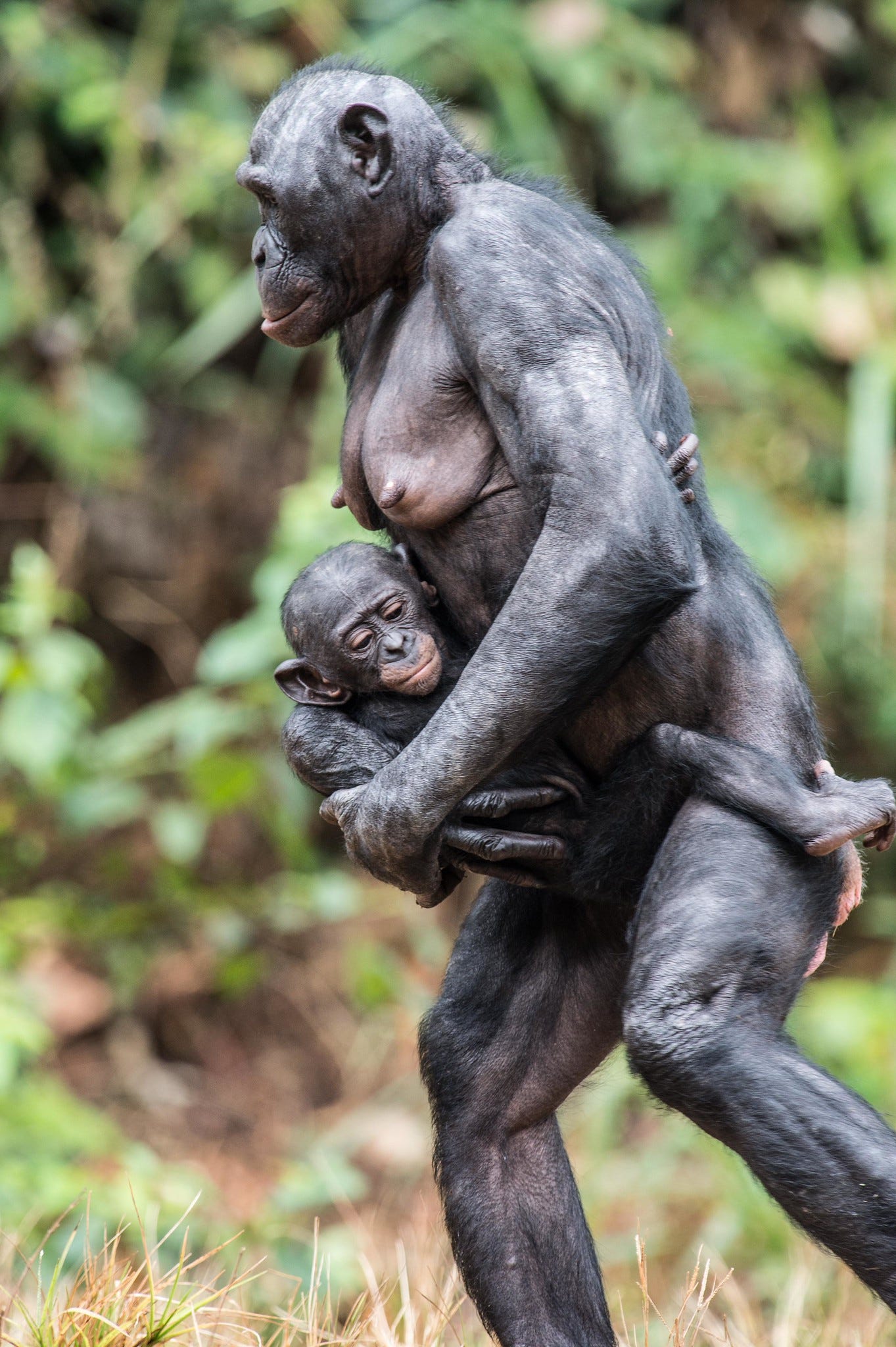
Scientists know as little about why many bonobos have breasts as about why human females have breasts. And in general, they do not seem to be interested, because as far as I can find, there are no scientific papers that even mention the question. One paper theorizes that human breasts are a byproduct of self-domestication.20 The article does not draw any analogy to bonobos regarding breast development. In any case: Now that females of two out of three members of the human-chimpanzee-bonobo genetical cluster have visible breasts to one or another degree, the question should be less why visible breasts evolved and more why males came to desire them so much, triggering further evolution.
A move to the Savannah
Let’s now move the above information from our cousins to Richard Wrangham’s hypothesis on the rise of the human mating system. In the situation described by Wrangham, ancestral humans live in multi-male multi-female groups, like chimpanzees or bonobos. Females are experimenting with a new technology to feed their children more efficiently. They face severe difficulties in actually getting any of the resulting food for themselves and for their children. So they form alliances with males: they give one male as much food as he wants, plus sexual access when he wants, in exchange for his protection against other males. That way they get some of the novel food for themselves and their children. However, all protectors are not equally good. The higher rank a protector has, the more thieves he can fend off. So for a female, the sport is to find an actually capable protector. Competition for the best protectors is rife.
Meanwhile, seen from the male side, no male is strong enough to monopolize all females. Every male can only protect as many as his strength and rank allows. So regardless of his rank, he will have to bet on a limited number.
And how can he successfully bet on the most reproductively efficient female or females? Present-day men often bet on youth, because young women have more reproductive years in front of them. This is, as everybody knows, a rather blunt bet. And it only (roughly) works in environments in which alliances are stable enough and life expectancy high enough. Presuming that ancestral humans still had some kind of estrus by that time, there is actually a much better way of estimating reproductive efficiency: Observing which females return to estrus at which time after giving birth. For every male, protecting a high-status female who can afford to have a baby every third year is much more genetically profitable than protecting a lower-status female who can only give birth at half of that rate.
And how can a male see whether a female is of the reproductively efficient kind or not? He can see which females return to estrus while still breastfeeding. Because only those reproductively efficient females will have enlarged breasts while being sexually receptive. Females who can afford to return to estrus only when past the breastfeeding phase will be much less interesting to males.
So we get a situation when the most attractive thing imaginable is to smell sexy/look sexy/behave sexy (whatever might have been the case among ancestors) while still having breasts inflated from breastfeeding. Estrus females with breasts were rich. Females in estrus without breasts will appear poor in comparison. Actually, all adult females without milk-producing breasts will look poor. Because the richest females can afford to always breastfeed, from one pregnancy to another. And if our ancestors were a bit like present-day chimpanzees, they felt that young females who had never conceived were untested cards that someone else could preferably test until they showed their true colors.
In summary, males had good reasons to direct their protective efforts toward women who could afford to have babies frequently and thereby always had breasts enlarged from breastfeeding. They had reason to de-prioritize women who only became sexually receptive when their chests were flat and had been so for a while. And how did the female side of evolution counter this discrimination against flat-chested women? It promoted genes for permanently enlarged breasts. That is, women evolved to trick men that they could afford to ovulate while breastfeeding although they couldn’t. They evolved a kind of breastfeeding prosthesis that made them look like rich, experienced mothers, although they weren’t.
And there ended the advantage for men to desire big breasts. But in a situation where most women have them, desiring them is no big disadvantage either. So by now, human males have spent what might amount to 1.5 to 2 million years desiring prostheses made of cheap fat.
Compared to competing hypotheses on why women have breasts, I think the above explanation has a big advantage: it does not only explain why permanent breasts evolved. It also explains why men came to desire female breasts. Most other hypotheses provide no good explanation to the level of interest that is shown by present-day males.21
Estrus or no estrus?
This hypothesis works well if we assume that estrus did not disappear before or immediately when humans started to form more stable male-female alliances centered around cooked food. Without the presence of estrus, it works less well. Then, large breasts would be a marker of infertility as well as a marker of affluence. It is indeed possible that permanently enlarged breasts would evolve also in a situation of concealed ovulation. Also then, higher-status females would breastfeed or be pregnant all the time. Which means that permanent breasts would be a sign of affluence. Whenever long-term affluence became important enough compared to short-term fertility windows, a male preference for enlarged breasts might have evolved. Bonobos actually combine enlarged breasts in many or most females with obscured ovulation. Since males care more about genital swellings than about breasts, enlarged breasts might, or might not, serve as an additional quality sign among them. As long as there is a sign of instant sexual attractiveness that is more important than clues of breastfeeding, males can start to tolerate such clues. And that is one step closer to being actively attracted to clues of breastfeeding, once long-term mating wins over short-term mating.
In any case, the time when humans started to form more stable couples was most likely a time for changing sexual preferences. Males no longer gained primarily from reacting to cues of instant fertility. To the contrary, they could gain from partnering up with females showing no or ambiguous cues of fertility, because that could make it more difficult for outsiders to sneak matings. After all, the reason for females to advertise ovulation is commonly assumed to be to incite competition among males and to confuse paternity in order to protect future infants from aggressive males. Males who would tolerate a lack of estrus signs and signs of probable non-ovulation (like enlarged breasts) were probably selected for, because it was simpler for them to actually monopolize a female. They could pick a female who was attractive for them but not-that-much for the other, estrus-fixated males. The other males would not know when to sneak matings, which would give the main protector an advantage. Non-estrus became a kind of pact between a woman and her protector: He protected her throughout the month, in return for her not seeking to attract competitors at a monthly peak-time.
But on an overall level, men and women were dishonest antagonists as well as honest cooperators. And the most plausible explanation to the evolution of permanent breasts seems to be part of a game that included theft, violence and deception.

D. Lukas and T. H. Clutton-Brock, The Evolution of Social Monogamy in Mammals, 2013. https://www.science.org/doi/10.1126/science.1238677
The only mammal known to live somewhat like humans, in groups with numerous males and females who form pairs, is the Patagonian mara, a big rodent that looks a bit like a rabbit. It achieves the feat in a totally opposite way compared to humans: The female has an extremely short window of sexual receptivity, so she only has the time to mate with one partner. But the Patagonian mara is not a group-living animal the way humans are. They put their young in a kind of daycare for security reasons, where they visit their pups once a day. The female nurses and the male stands guard outside. Otherwise the Patagonian mara is a pair-living animal that spends its days foraging in pairs. Smithsonian’s National Zoo & Conservation Biology Institute, https://nationalzoo.si.edu/animals/patagonian-mara, Wikipedia on the Patagonian mara, https://en.wikipedia.org/wiki/Patagonian_mara
L. L. Langness, Sexual Antagonism in the New Guinea Highlands: A Bena Bena Example, 1967, https://www.jstor.org/stable/40329590
For a pre-historical inquiry, see Rozenn Colleter , Klervia Jaouen , Dominique Garcia , Michael P Richards, Dietary inequality marker reveals 10,000 years of gender and cultural disparity in Europe, 2026, https://academic.oup.com/pnasnexus/article/5/4/pgag033/8586686?login=false
Male reproductive skew is higher in bonobos than chimpanzees, Martin Surbeck 1 6, Kevin E. Langergraber 2 3 6, Barbara Fruth 4 5, Linda Vigilant 1, Gottfried Hohmann
Joel Bray, Anne E. Pusey; Ian C. Gilby, Incomplete control and concessions explain mating skew in male chimpanzees https://royalsocietypublishing.org/rspb/article/283/1842/20162071/78300/Incomplete-control-and-concessions-explain-mating
Kimberly G. Duffy, Richard W. Wrangham, Joan B. Silk, 2007, Male chimpanzees exchange political support for mating opportunities, https://www.sciencedirect.com/science/article/pii/S0960982207014960
Richard W. Wrangham, James Holland Jones, Greg Laden, David Pilbeam, and NancyLou Conklin-Brittain, The Raw and the Stolen - Cooking and the Ecology of Human Origins, 1999 https://web.stanford.edu/~jhj1/papers/wrangham_etal1999.pdf
Cristina Gomes and Christophe Boesch, Wild Chimpanzees Exchange Meat for Sex on a Long-Term Basis, 2009, https://www.researchgate.net/publication/24263422_Wild_Chimpanzees_Exchange_Meat_for_Sex_on_a_Long-Term_Basis
Richard W. Wrangham, James Holland Jones, Greg Laden, David Pilbeam, and NancyLou Conklin-Brittain, The Raw and the Stolen - Cooking and the Ecology of Human Origins, 1999, https://web.stanford.edu/~jhj1/papers/wrangham_etal1999.pdf
The idea of male exploitation of females as the very beginning of social class might not be entirely established, but it is indeed old. For example, Thorstein Veblen outlined the concept in The Theory of the Leisure Class: An Economic Study of Institutions, 1899
Richard Wrangham, Catching Fire - How Cooking Made Us Human, 2009, 41 percent of e-book
V L Katch, B Campaigne, P Freedson, S Sady, F I Katch, A R Behnke, Contribution of breast volume and weight to body fat distribution in females, 1980, https://pubmed.ncbi.nlm.nih.gov/7416252/
See for example Martin N. Muller, Melissa Emery Thompson, Richard W. Wrangham: Male Chimpanzees Prefer Mating with Old Females, 2006, https://www.cell.com/current-biology/fulltext/S0960-9822(06)02267-6
J. Wallis, A survey of reproductive parameters in the free-ranging chimpanzees of Gombe National Park., 1997, https://www.google.com/url?sa=i&source=web&rct=j&url=https://scispace.com/pdf/a-survey-of-reproductive-parameters-in-the-free-ranging-52mkh1z9en.pdf&ved=2ahUKEwiHpdmoxreWAxUVksMKHU2BEEgQ_r4PegYIAAguEDI&opi=89978449&cd&psig=AOvVaw1ZNZRu6tOs5FltlWpfDdKM&ust=1787601944986000
Toshisada Nishida et al., Demography, Female Life History, and Reproductive Profiles Among the Chimpanzees of Mahale, 2003
Melissa Emery Thompson , Martin N. Muller , Richard W. Wrangham, The energetics of lactation and the return to fecundity in wild chimpanzees, 2012https://academic.oup.com/beheco/article-abstract/23/6/1234/190391redirectedFrom=fulltext&login=false
Chie Hashimoto, Heungjin Ryu, Keiko Mouri, Keiko Shimizu, Tetsuya Sakamaki, Takeshi Furuichi, Physical, behavioral, and hormonal changes in the resumption of sexual receptivity during postpartum infertility in female bonobos at Wamba, 2022
The internet indicates that this is the case. I don’t find any really good source for this, other than images of very flat-chested, young-looking female bonobos.
Bogusław Pawłowski and Agnieszka Zelazniewicz, The evolution of perennially enlarged breasts in women: a critical review and a novel hypothesis, 2021, https://onlinelibrary.wiley.com/doi/10.1111/brv.12778
The one that does, the handicap theory of female breasts by biologists Avishag and Amotz Zahavi, contains another obvious problem: choosing a partner with a handicap only makes sense to individuals who receive genes and little else from a partner. Since women typically carry the biggest workload as family providers, choosing a handicapped woman makes little sense.
I think the part of your theory that marriage evolved for purposes of men securing food provisioning from women is actually still apparent in some very primitive African hunter gatherer societies, who are in the environment closest to what humans mostly evolved in. We modern people think that the traditional role of a man is providing and protecting. However, in hot weather societies that never experienced the agriculture trap, it is more common that mothers are the primary provisioner for their own children- they provide more than 50% of a tribes caloric value, sometimes for the men as well. In those places, you see men living comparatively leisurely lives to the women on a day to day basis but ready to fight off outsider men. So there are still places when men mainly protect and provide inconsistently and less than what the woman provides for herself and her children.
I am pretty sure this long post is overthinking it. God made women's breasts for the same reason he made beer: because He loves men and wants them to be happy. Or alcoholics and forever frustrated, it's hard to tell.